Showing posts with label moon. Show all posts

Monday, November 7, 2016

What is a Supermoon?

The astronomical news this month is all about the "Supermoon" happening on the night of 14th November 2016. But what is a Supermoon, and why is it different to any other Full Moon?

Let's start simple, with what it means to have a Full Moon. All this means is that the Moon is in the point of its orbit around the Earth which puts it directly opposite the Sun in the sky. As a result the side of the Moon we see is fully illuminated by the Sun, and the Moon rises at sunset (and sets at sunrise) making it visible all night.

Diagram illustrating how the phase of the Moon depends on its position in its orbit around the Earth relative to the location of the Sun. In this diagram the Sun is not shown, but it is to the right, directly above the point on the Earth labelled "Noon". Credit: Wikimedia, Thomas Splettstoesser.
 So obviously, the Full Moon happens once in every lunar orbit around the Earth (well technically slightly less, because meanwhile the Earth is also orbiting the Sun, but let's not worry about that). Now the orbit of the Moon isn't perfectly circular. It's very slightly oval shaped, with a point (which is called the "perigee") when the Moon is at its closest to the Earth, and a point (called "apogee") when it is at its furthest.


This difference is very small - much smaller than shown in the diagram above. If I drew an oval with the right proportions you couldn't tell it wasn't a circle! The mean distance to the Moon is 384,400 km, the closest approach is just 21,296 km closer than this. That might sound a lot, but it's just 5% closer than the average (an apogee is 5% more distant than average). 

A Supermoon is just the name we give for a Full Moon which happens when the Moon is at or close to perigee (i.e. it's closest point to the Earth). Being 5% closer than average makes the Moon look a barely noticeable 5% larger, however the impact on its brightness is more significant, making Supermoons the spectacle that gets attention. A Supermoon will be 30% brighter than a Full Moon at apogee. High and low tides will also be more extreme when the Moon is closer.
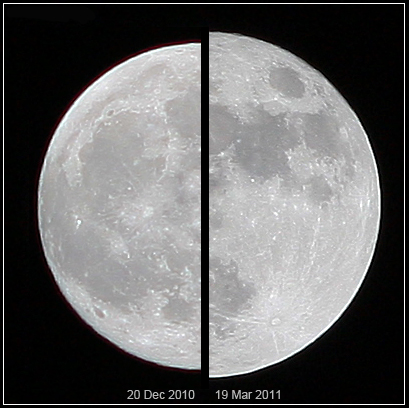
 
The Supermoon of 19th March 2011 (right) compared to an average full Moon (left). Credit: Wikimedia, Marco Langbroek.

Now how close the Supermoon is to the exact point of perigee determines the exact distance to the Full Moon and how super the Supermoon is. The upcoming Full Moon happens at 3pm GMT, Monday 14th November 2016, when the Moon is within 1.5 hours of passing through perigee, making it a "super Supermoon". 

 What's more, the distance of lunar perigee also varies slightly (caused by the gravity of other planets in the Solar System and various resonances). The November 14th perigee happens to be a  close one. This means that 14th November is really a super-dooper Supermoon; a lunar perigee hasn't happened so close to the Earth since January 26, 1948, and the next Full Moon which is so close will be November 25, 2034.

 While these are relatively rare events, the noticeable difference in the Moon is quite small. The Full Moon is well worth catching every month, even if the nights of 13th/14th November 2016 ti will be slightly brighter and larger than average.
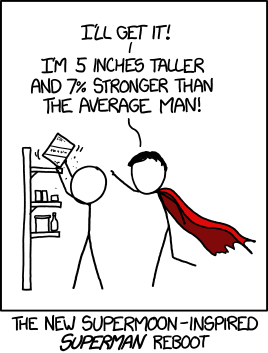
xkcd comic explaining the Supermoon.


 And be aware that Supermoons are getting gradually less super. The Moon is very slowly moving away from the Earth. However as it's moving away at just 3.8cm each year, it'll be a while (a few billion years) before this makes any noticeable difference.


Tuesday, August 9, 2016

Once in a Blue Moon

  Last week was full of interesting Moon news. “Moon Express” has become the first commercial company approved to try to land on the Moon, on the same day that the Chinese Moon Rover, “Jade Rabbit”, said goodbye (tweeting “This time it really is goodnight/ There are still many questions I would like answers to, but I'm the rabbit that has seen the most stars."  on Weibo, the Chinese version of Twitter), after surviving for more than 18 months longer than its planned 3 month mission.

Blue Moon of December 2009. Credit: Codybird, Wikimedia


To date, just three nations have landed on the Moon. The Jade Rabbit rover, named after the pet rabbit (YuTu) of the Chinese Moon goddess, Change’e, joined over 80 different US and Russian probes on the surface, as well as the remnants of the Apollo missions which saw 10 American men walk on the Moon’s surface in the 1960s and 1970s.

The success of the Chinese rover is exciting enough, but the news from Moon Express could be a signal of the start of a new era of Moon exploration. Moon Express is just one of sixteen groups aiming for the Google Lunar X-Prize. This competition, launched in 2007, calls for a privately funded rover to land on the Moon drive at least 500m and transmit back HD video and images before the end of 2017. The first group to do this can claim a $20m prize, as well as a place in space history.

This week is significant as Moon Express has passed on of the big unknowns in the mission. The Outer Space Treaty, made in 1967, sets out the rules about what National space programmes can and cannot do in space, and also states that the activities of non-governmental entities in outer space, requires authorisation and supervision by one of the State Parties to the Treaty. This meant that, unlike the many companies who are now launching into low Earth orbit, governmental permission is needed for any commercially planned Moon landing. This is the first time that permission has been sought, and is would have been a complete unknown who among the various US bodies needed to give permission to the Californian based company.

 In the end a cabal of federal agencies were involved, from the Federal Aviation Authority, NASA of course, and even the White House, taking almost 4 months to assess the application. Permission has been granted for a single mission only, and Moon Express has a launch date scheduled towards the end of 2017 which if it manages to meet will not only win it the X-prize, but also make it the first commercial enterprise to make it into outer space.

 Meanwhile other nations are looking Moonward. Both South and North Korea have stated ambitions to land a robotic mission on the Moon within the next decade, and Russia, ESA, NASA and Japan currently have plans to send people to the Moon. The first of these missions could see Americans return to the Moon in preparation for Mars missions as soon as 2023; development and construction of the new Orion Spacecraft is ongoing at NASA, and the first planned test mission of this deep space vessel will see it go into lunar orbit.

 The Moon is seen as a safe stepping stone to longer missions. A place to learn about how to live and work long term in space just a few days away from Earth rather than the months it would take to get to Mars. Commercially the Moon provides a potential mining resource (especially for high value elements rarely found on Eart), and astronomers like myself are excited about the potential for Moon based observatories, perhaps radio telescopes on the far side of the Moon shielded from the human radio noise.

 After decades of inaction, it seems the time is ripe to return to the Moon.

If you want to see the Moon tonight look for the crescent Moon lingering after sunset in the evening skies; you can see the first full Moon of August (which rises as the Sun sets) on August 18th. The next Blue Moon (defined as a rare second full Moon in single month) will occur on 31st Jan 2018.

Thursday, March 29, 2012

Visiting Jodrell Bank as part of the UK National Astronomy Meeting

I'm in Manchester this week at the UK National Astronomy Meeting. As part of this, yesterday evening I went on a visit to the Jodrell Bank Observatory, with 120 other astronomers.

NAM Astronomers at JBO
It was a gorgeous spring evening, and the disk looked lovely as a contrast to the beauty of spring around it.

Jodrell Bank and a sheep

The Sun through the dish

Jodrell Bank and some daffodils

Jodell Bank and spring blossom


Jodrell Bank and a hedge of forsythia

We got to walk under the dish too. Here we are crossing the track which the telescope uses to rotate in azimuth.

Jodrell Bank azimuth track
And we stood under the dead centre of the dish.

Looking up at the base of Jodrell Bank

That's me directly under the centre of the dish
The sky was clear, and the crescent Moon was prominent, see if you can spot it through the dish below.


Required picture of me with the dish


We also got a tour of the control room - and the set of BBC Stargazing LIVE of course. 


And we're astronomers, so we like the details - this is some of the computers which run Jodrell Bank when it works with the eMerlin network of UK radio telescopes.


It need as "Totally Accurate Clock" to do this (actually that's totally true).


Our visit ended with a dinner in the cafe. We sat outside with the above view of the sky, and I saw Venus in the daytime finally. :) I think it's in the below image, but I haven't spotted it yet!

Moon and Venus in daytime, 28th March 2012