Showing posts with label beautiful galaxies. Show all posts

Friday, October 5, 2012

LOFAR observation of beautiful galaxy, M87

I just posted the below over on the LOFAR-UK blog, but is also fits into my series of Messier Object posts - this one M87, which has a beauty in the eye of the beholder perhaps as a "boring" elliptical, but check out that jet from it's actively accreting supermassive black hole. Amazing!

****************

A paper appears on the arxiv today with new images of the centre of nearby elliptical galaxy M87, taken with the Dutch LOFAR stations.

M87 at Metre Wavelenghts: the LOFAR Picture, by de Gasperin et al. (A&A in press).

M87 (also known at Virgo-A) is one of the two massive elliptical galaxies found at the centre of our nearest cluster of galaxies (the Virgo cluster).

In the centre of M87 is a well know actively accreting supermassive black hole, which is emitting jets of energetic particles which emit significant amounts of radio. These jets are even (just) visible in optical images of M87 (the blue line below).

Optical image of M87 taken with Hubble Space Telescope. Scale 3x3 arcmins.  More details. 

M87 has often been a poster child for radio astronomy images. These images of the jet taken by the NRAO's VLA can be seen in many talks about radio galaxies and AGN.


M87 imaged at 90cm (300 Mhz) with the VLA. Scale 15x15 arcmin. More details. 
And especially this series of images zooming into the central regions.

For more details see the APOD entry for this image

The paper on the arxiv today used observations of M87 with both the HBA and LBA arrays of LOFAR. The Dutch stations only were used in this observation - adding in international stations like Chilbolton will be able to increase the resolution even further, and I will look forward to seeing that in the future.

I have extracted two of the images from the paper. This first was taken with the HBA at 140 MHz (2.1 m) and shows an area 15x15 arcmin in size (same as the VLA image above, but at wavelengths more than twice as large).


And this shows one of the many LBA images made - this one at 25 Mhz (12m) of a slightly larger sky area (21x21 arcmin). 


These new observations at lower frequencies than ever before allow scientists to better constrain the spectral shape of the radio emission from the jets, which in turn can be used to constrain the details of how the supermassive black hole in the centre of M87 is able to power these extremely extended emission regions.


Thursday, May 3, 2012

Beautiful Galaxy M106

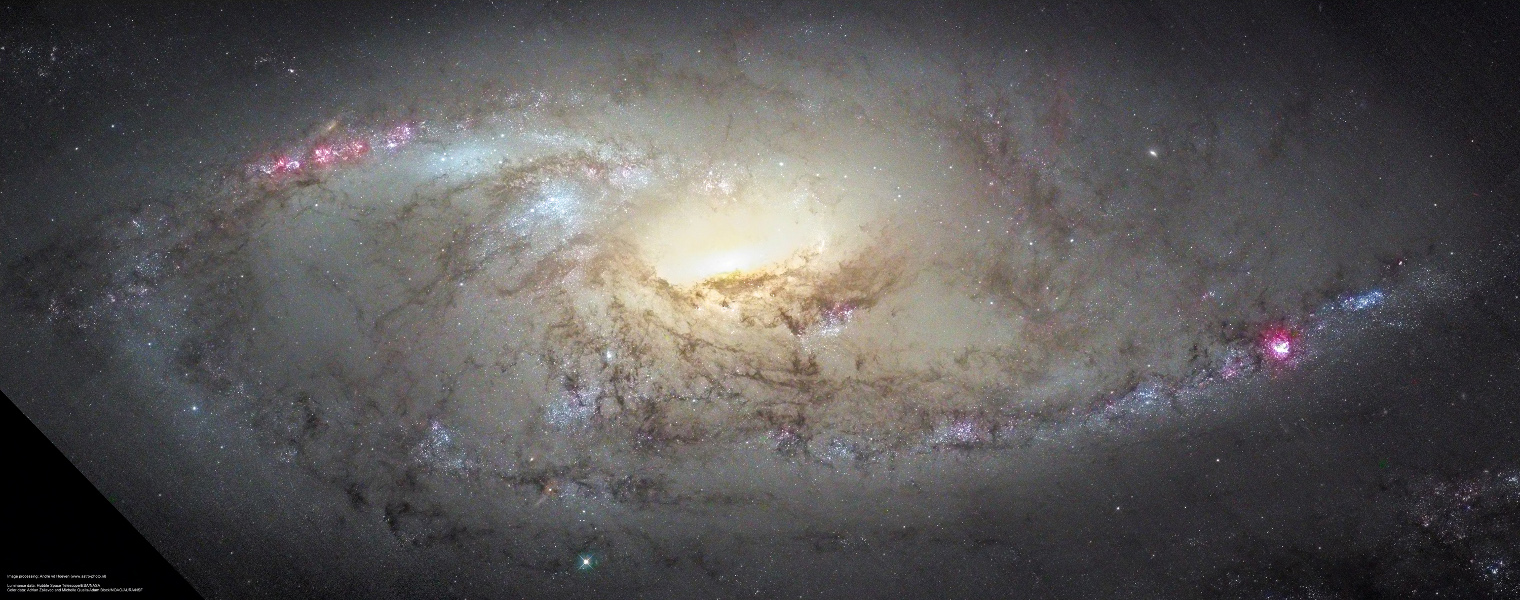
The next in my series of beautiful galaxies is inspired by today's Astronomy Picture of the Day Image.

M106 Close Up (from APOD)
Credit: Composite Image Data - Hubble Legacy ArchiveAdrian Zsilavec, Michelle Qualls, Adam Block / NOAO / AURA / NSF
Processing - AndrĂ© van der Hoeven

This is a composite Hubble Space Telescope and ground based (from NOAO) image. The ground based image was used to add colour to the high resolution single filter (ie. black and white) image from HST.

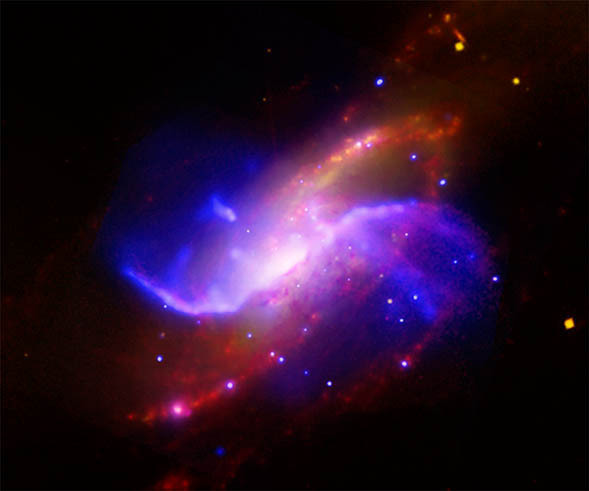
M106 has traditionally been classified as an unbarred Sb galaxies (although some astronomers claim a weak bar). In the 1960s it was discovered that if you look at M106 in radio and X-ray two additional "ghostly arms" appear, almost at right angles to the optical arms. These are explained as gas being shock heated by jets coming out of the central supermassive black hole (see Spitzer press release).

In this composite image of spiral galaxy M106 (NGC 4258), optical data from the Digitized Sky Survey is shown as yellow, radio data from the Very Large Array appears as purple, X-ray data from Chandra is coded blue, and infrared data from the Spitzer Space Telescope appears red. Credit: 


X-ray: NASA/CXC/Univ. of Maryland/A.S. Wilson et al.; Optical: Palomar Observatory. DSS; IR:NASA/JPL-Caltech; VLA: NRAO/AUI/NSF


Messier 106 (or NGC 4258) is an extremely important galaxy for astronomers, due to it's role in tying down the extragalactic distance scale. A search in the NASA Extragalactic Database (NED) will reveal this galaxy has 55 separate estimates of its distance, using many of the classic methods on the Cosmic distance ladder. Most importantly, M106 was the first galaxy to have an geometric distance measure using a new method which tracked the orbits of clumps of gas moving around the supermassive black hole in its centre. This remains one of the most accurate extragalactic distances ever measured with only a 4% error (7.2+/-0.3 Mpc, or 22+/-1 million light years). The error can be so low, because the number of assumptions is small (it's based on our knowledge of gravity), and as a geometrically estimated distance it leap frogs the lower rungs of the distance ladder.

This result was published in Nature in 1999: A geometric distance to the galaxy NGC4258 from orbital motions in a nuclear gas disk, Hernstein et al. 1999 (link includes an open access copy on the ArXiV). 


Because M106 has so many different distances estimated using so many different methods, and is anchored by the extremely accurate geometric distance, it helps us to calibrate the distances to many other galaxies. Almost all cosmological results, and any result looking at the masses, or physical sizes of galaxies need a distance estimate. 


So M106 is not only beautiful, it's important.  


I've cross listed this post at the Galaxy Zoo blog. 

Thursday, April 19, 2012

Beautiful Galaxy M61

One of my favourite hashtags on Twitter is #bbcstargazing. During the programme I followed this to answer astronomy questions sent to it. Something I enjoyed the challenge of in 140 characters, and would love to continue if you tweet questions tagged #askastronomy.

Now the  #bbcstargazing hashtag is mostly astrophotographers posting their latest image. This morning the image being retweeted (RT) is this one of M61 taken by Daniel Marlow (@drm3107).

M61. Credit: Daniel Marlow
So it seemed like a good time for the next beautiful galaxy post - this one about M61.

Messier 61, is a bright spiral galaxy in the Southern extremity of the Virgo Cluster (our nearest large cluster of galaxies). It's notable astrophysically for having had 6 supernova observed in it, which apparently ties it with M83 as the Messier galaxy with the most observed supernova, but none of the supernova in M61 have been of the Type1a used to measure cosmological distances.

And the distance to M61 is a bit tricky to estimate. Being near the Virgo cluster whose large mass distorts the usual relationship between recessional velocity and distance you can't really just use the redshift of M61 to give it's distance, and other distance measurements listed in NED for M61 range from about 30 million - 90 million light years (10.1-35.5 Mpc). If it's at the distance of the centre of Virgo it's probably about 50 million light years away (16 Mpc).

Assuming that distance the size of M61 is quite similar to the Milky Way, and so is it's morphology. It's historical classification lists it as a weakly barred Sbc galaxy. It also host an actively accreting black hole in its centre.

Here is the Sloan Digital Sky Survey image of it:

M61: Credit SDSS
Another beautiful galaxy.

Links: LookUP on M61; SEDS on M61; NASA Extragalactic Database on M61; Wikipedia on M61.

Wednesday, March 21, 2012

Beautiful Galaxy M101 in wide field

M101 is becoming one of my favourite galaxies - not least because the post I did about it when a Supernova was discovered in it last August is the 3rd most read here.

So I was pleased to notice on the Twitter #bbcstargazing stream a link to a beautiful wide field shot of the galaxy.


And here's the image in its full glory from the Flickr stream:
M101 Widefield - 190312
M101 Widefield by Mike Hyde on Flickr.

So why do I like this image so much.... well I was just talking about it with my office mate Chris and he put it well. You can see the galaxy, and you can tell it's a galaxy made of billions of stars and unimaginably immense on human scales, but you can also get a sense of how tiny this galaxy is compared to the Universe, and even how tiny it appears on the sky from Earth. Check out the other galaxies in the image - an edge on disc towards the bottom, and a fuzzy patch at the upper right. 

And Chris (who works on supernova projects) tells me the supernova in it is still quite bright. It's currently about 16th magnitude - even months after it went it. Now that's not quite visible in this image, but still giving useful information via even quite small professional telescopes. There's already been several papers based on it discussing distance measurements to M101 and the scale of the Universe. 

Great image. :)

Monday, March 19, 2012

Beautiful Galaxy M95 - another Supernova!

There's been another bright supernova in a galaxy on the Messier list - this time M95 (which is currently near Mars on the sky, so fun for amateur astronomer to try - visit that link to see a finding chart of where it should be).

M95 is a beautiful barred spiral galaxy - one of my favourite kinds of galaxy at the moment. The below image of it was taken by astronomers using the William Herschel telescope, and shows the bar across the centre, with a ring of star formation surrounding it. Barred galaxies quite commonly will have rings around the outer edges of the bar, and M95 has been called a "typical ringed galaxy" (by the famous astronomer Alan Sandage).

M95. Credit: Johan Knapen (ING) and Nik Szymanek.


Here's M95 in the SDSS three colour images we use in Galaxy Zoo.

M95. Credit: SDSS


There is a stunning image of M95 taken by the Spitzer IR telescope as part of the SINGS survey of nearby galaxies (below). This image in red shows the interstellar dust around regions of intense star formation in the ring (link to Spitzer description)

M95 in IR. Credit: Spitzer/SINGS
The book I have on the Messier Objects (which is lovely - Amazon link here), says that M95 is just one of a handful of barred spirals in the list, and says that you can just trying to see it using 10x50 binoculars. Given it's location close to Mars it'd be an excellent thing to try for with a telescope about now.

Historically in astronomy M95 is important as a member of the set of galaxies using in the Hubble Key Project to measure the rate of the expansion of the Universe. These measurements give it a distances of about 30 million light years away.

NED page on M95
Wikipedia article on M95

Friday, February 3, 2012

Galaxy Zoo Blog: Another Galactic Twin

I just blogged over at Galaxy Zoo about the below image of a beautiful barred spiral: Another Galactic Twin?

NGC 1073: A Galactic Twin? Credit: ESA/NASA

Thursday, August 25, 2011

A Supernova in Beautiful Galaxy M101

After starting my series of beautiful galaxies with Messier 100 I was amused to discover this morning that M101 (The Pinwheel Galaxy) is in the astronomical news after a possible Type 1a Supernova was discovered in it yesterday. So following M100 I obviously have to do M101 this morning!

M101 as seen in a mosaic of Hubble Space Telescope images added to some ground based data. Credit: NASA and Robert Gendler. For more info see APOD
M101 was classified in the Hubble Atlas as an Sc galaxies with a weak bar and a partial ring around the bar before the arms emerge (SAB(rs)c). It's illustrated twice in the atlas, with the largest illustration accompanied by text which describes it as the prototype of multiple armed Sc galaxies, what we might today call a "flocculent" spiral.

 According to the "Atlas of the Messier Objects", M101 is the third largest galaxy (in angular size) in the Messier list, and is visible as an extended object even through 10x50 binoculars (presumably only from a very dark site though). It definitely seems to be a popular deep sky object for amateurs, and following the SN1a discovery the AAVSO have put out a call for their members to get observing. Some predictions suggest the supernova is still brightening and could reach 10th magnitude - only 2 magnitudes fainter than Neptune (at its brightest).

 M101 has already been an important calibrating object for the extragalactic distance ladder having had its distance measured using many of the well known methods (e.g. the Leavitt Law (Cepheids), Tip of the Red Giant Branch, the Tully-Fisher relation). The most reliable distances have ranged from 6-8 Mpc (18-24 million light years or so) making the galaxy almost twice as large as our own Milky Way.

 The addition of a Type 1a Supernova in M101 would obviously be extremely exciting as a way to further link commonly used distance indicators. SNIa are an important type of object in astronomy - they are extremely bright, and therefore observable at very large distances. Much of the evidence for the acceleration of the expansion of the universe (which indicates the need for "dark energy") comes from measurements of SN1a at very large distances which suggest that in the past the universe was expanding more slowly than it is today!

 It will be interesting to see the result of the many follow-up observations of the SN in M101 - and exciting to think they are happening (on the other side of the world of course) as I write this.

Wednesday, August 17, 2011

What is Hoag's Object?

Perhaps one of the most striking looking galaxies I know of is "Hoag's Object" (seen below by the Hubble Space Telescope; NED information, Wikipedia articlelookUP information). The wikipedia article talks of it as an object which fascinates both amateur and professional astronomers.

 I am really curious to know how it might look through an amateur telescope, and I'd love to see it for myself some day (RA=15 17 14, Dec=+21 35 08 in the Serpens constellation), Astrometry.net can help give an idea - see Hoag's Object images on Flickr found by the service.

HST Image of Hoag's Object. Credit: NASA.

Through HST as you can see the object appears to be made up of a red spheroidal core, surrounded by a blue ring of star formation (with a gap between the two). The ring shows some spiral structure. In my opinion, one of the most fun things about the object is the more distance ring galaxy which can be seen through the gap (just to the right of 12 o'clock). This to me demonstrates the sheer size of the universe. To find such a rare object behind such a rare object seems quite extraordinary. 

So why am writing about Hoag's Object today, well appearing on the arXiV this morning is a paper addressing the formation scenarios for Hoag's Object (Finkelman et al. 2011, MNRAS in press), which struck my interest so I thought I'd write about it. It puts forward a new scenario for the formation of this unusual object as well as talking about the two previously suggested models. In addition they present some new data for our consideration.

 The three models discussed are:

1. Ring formed as a collisional ring.

In this model another galaxy would have passed through the centre of Hoag's object, and what is observed is the merger remnant. The Cartwheel Galaxy is perhaps the most famous of this class of objects. It's shown below in a HST image, and illustrates the most obvious problem with interpreting Hoag's Object in this way.

Cartwheel Galaxy. Credit: HST, NASA
You can see quite clearly in the above image the culprits in the galactic collision. No such neighbours exist for Hoag's Object. In addition the ring appears to be at rest with respect to the central spheroid - which would be unlikely if the ring were collisional.

2. Ring formed through a bar instability which has since dissolved. 

 In this model at an earlier time there would have been a strong bar, and material would have flowed out along it to form the ring. The main objection to this theory appears to be the lack of evidence for any residual bar in the central spheroid. I should perhaps point out that this was a theory previously put forward by one of the co-authors of today's paper (Noah Brosch), so presumably his co-authorship on this new paper is an indication that he no longer believes this to be the best model.

3. Gas Accretion. 

This is the new theory put forward (although I should say it seems rather similar to me to one discussed by Schwiezer et al. 1987). In this model the object has a very low density HI disk which accreted at early times onto the spheroid and is only dense enough to form stars in the ring.

In fact the kinematic data does seem to suggest that Hoag's object (other than having its only visible disk light in a ring of course) is a normal disk galaxy, with the spheroidal component playing the role of a central classical bulge. At the risk of getting too technical in a blog, check out the Halpha velocity map and HI line profile below.

Ignoring the gap in the Halpha velocity map these two observations look to me basically identical to what you would expect from a normal nearly face-on disk galaxy. The classic "double horned" HI profile is usual interpreted as a coming from a rotating disk of HI with a central gap. HI (atomic hydrogen in its ground state) emits (due to hyperfine spitting of the ground state) at a single frequency of 1420 Mz (21cm) - the broadening of the line is caused by Doppler shifting of the emission (indicated along the x-axis is the velocity of the Doppler shifter HI line) and the peaks at the maximum velocity are interpreted as a pile up of HI in the flat part of a galaxy rotation curve (see global HI profiles, or galaxy rotation curves for more information on this).

HI in Hoag's Object from Schwiezer et al. 1987

The Halpha velocity map is showing a similar thing. Halpha is a spectral line emitted by excited hydrogen. Again this emits at a single frequency (656.28 nm), which is shifted due to the Doppler effect. The map shows the velocity of this line colour coded such that red indicates a greater velocity than the mean for the galaxy and blue a smaller. This is again interpreted as a rotating disk of hydrogen with the upper left moving away from use and the lower right towards us. The velocities are very consistent with what's seen in the HI profile, suggesting the HI is indeed coming from the ring.
Halpha velocity field in Hoag's Object from Finkelman et al. 2011

 What is needed to complete this picture is a HI map of Hoag's Object. I think this could be fairly easilly done with the EVLA, and I will be interested to see it when it is.


Wednesday, July 13, 2011

Beautiful Galaxy M100

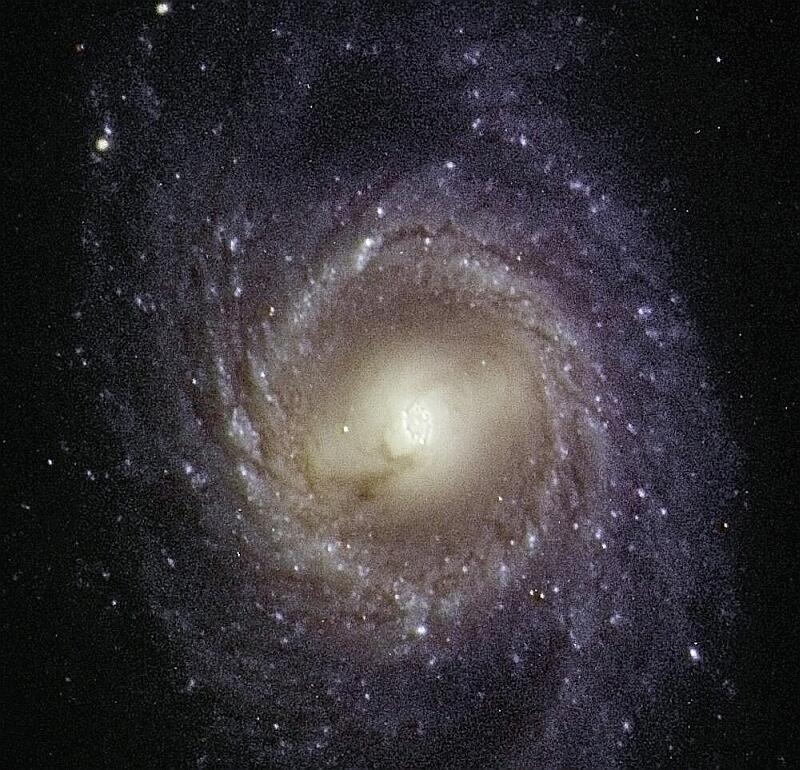
I stumbled across a picture of the galaxy Messier 100 (NGC 4321) this morning, and just felt inspired to share it's beauty. I might share more of these as a way for me to learn the NGC numbers of some classic galaxy examples!

 So here it is - as seen by the Sloan Digital Sky Survey.

M100 as seen by the Sloan Digital Sky Survey
The central region has been observed by HST, which is also worth a look.

The central region of M100 seen by the Hubble Space Telescope.
And I encourage you to do a Google Image Search on Messier 100 to see the vast array of beautiful images of this galaxy (PS. avoid searching on M100 if you're squeamish. Yuck!).

M100 is a classic example of a grand design spiral, meaning it has clear well defined spiral arms. And look how far round they wind - it's lovely. Its classic classification (from the RC3 as listed in NED) is as an Sbc galaxy with a weak bar and an inner ring (SAB(s)bc). Apparently it's a similar size galaxy to our own Milky Way, and has played an important role in the history of extragalactic astronomy. This object is a member of our nearest large cluster of galaxies - the Virgo Cluster, and in 1994 was the first galaxy in the Virgo Cluster to have a distance measured to it using Cepheid Variables (via the Leavitt Law, see Freedman et al. 1994) which was an important step towards a reliable measurement of the Hubble constant.

Oh, and I should put in a plug for the excellent LookUP website, by @astronomyblog (Stuart Lowe). Check out the LookUP entry for M100 - turns out it also has a very interesting black hole - possibly the youngest known, and born in the same year as me. Cool!