A couple more fun things on the Transit of Venus.
First, a blog post about actually using measurements to calculate the distance to the Sun: Easter Island Transit of Venus, by David Rodriguez.
I particularly like this plot, showing the timing measurement versus position relative to the centre of the Earth:
And the calculation isn't bad, 151+/-20 million km. Only a factor of 10 error larger than the best scientists in the world could do in the 18th century.
Also really neat is this 3D image made by Peter Lawrence (@Advertvision on twitter) which uses image of the transit taken almost simultaneously in the northern Norway (by Pete) and Australia (by expert imager Paul Hause). You can see the parallax of Venus on the disc of the Sun with your own eye, and use red-green 3D glasses to see it in 3D. Must find a pair... :)
"The strongest affection and utmost zeal should, I think, promote the studies concerned with the most beautiful objects. This is the discipline that deals with the universe's divine revolutions, the stars' motions, sizes, distances, risings and settings . . . for what is more beautiful than heaven?" - Nicolas Copernicus
Showing posts with label distance ladder. Show all posts
Monday, June 18, 2012
Thursday, May 3, 2012
Beautiful Galaxy M106
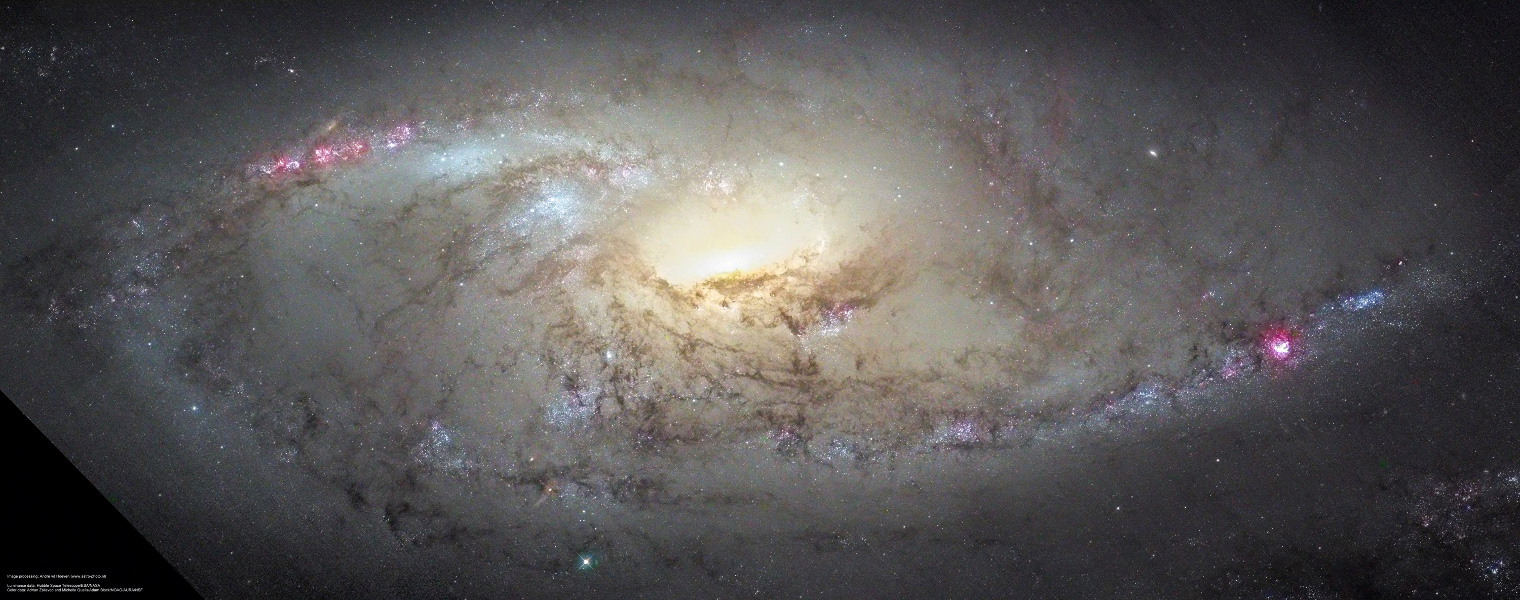
The next in my series of beautiful galaxies is inspired by today's Astronomy Picture of the Day Image.
This is a composite Hubble Space Telescope and ground based (from NOAO) image. The ground based image was used to add colour to the high resolution single filter (ie. black and white) image from HST.
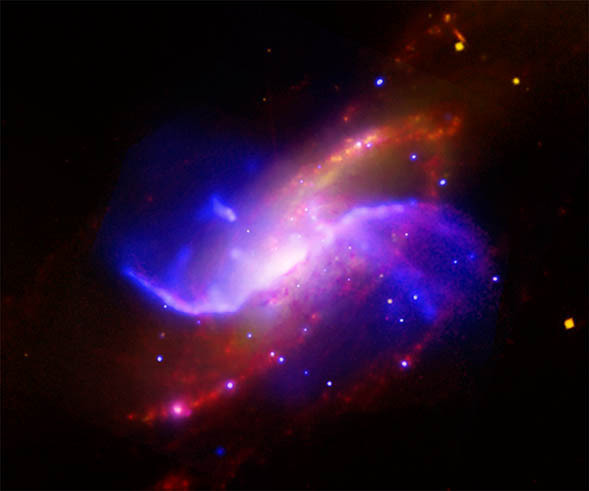
M106 has traditionally been classified as an unbarred Sb galaxies (although some astronomers claim a weak bar). In the 1960s it was discovered that if you look at M106 in radio and X-ray two additional "ghostly arms" appear, almost at right angles to the optical arms. These are explained as gas being shock heated by jets coming out of the central supermassive black hole (see Spitzer press release).
Messier 106 (or NGC 4258) is an extremely important galaxy for astronomers, due to it's role in tying down the extragalactic distance scale. A search in the NASA Extragalactic Database (NED) will reveal this galaxy has 55 separate estimates of its distance, using many of the classic methods on the Cosmic distance ladder. Most importantly, M106 was the first galaxy to have an geometric distance measure using a new method which tracked the orbits of clumps of gas moving around the supermassive black hole in its centre. This remains one of the most accurate extragalactic distances ever measured with only a 4% error (7.2+/-0.3 Mpc, or 22+/-1 million light years). The error can be so low, because the number of assumptions is small (it's based on our knowledge of gravity), and as a geometrically estimated distance it leap frogs the lower rungs of the distance ladder.
This result was published in Nature in 1999: A geometric distance to the galaxy NGC4258 from orbital motions in a nuclear gas disk, Hernstein et al. 1999 (link includes an open access copy on the ArXiV).
Because M106 has so many different distances estimated using so many different methods, and is anchored by the extremely accurate geometric distance, it helps us to calibrate the distances to many other galaxies. Almost all cosmological results, and any result looking at the masses, or physical sizes of galaxies need a distance estimate.
So M106 is not only beautiful, it's important.
I've cross listed this post at the Galaxy Zoo blog.
![]() |
| M106 Close Up (from APOD) Credit: Composite Image Data - Hubble Legacy Archive; Adrian Zsilavec, Michelle Qualls, Adam Block / NOAO / AURA / NSF Processing - André van der Hoeven |
This is a composite Hubble Space Telescope and ground based (from NOAO) image. The ground based image was used to add colour to the high resolution single filter (ie. black and white) image from HST.
M106 has traditionally been classified as an unbarred Sb galaxies (although some astronomers claim a weak bar). In the 1960s it was discovered that if you look at M106 in radio and X-ray two additional "ghostly arms" appear, almost at right angles to the optical arms. These are explained as gas being shock heated by jets coming out of the central supermassive black hole (see Spitzer press release).
Messier 106 (or NGC 4258) is an extremely important galaxy for astronomers, due to it's role in tying down the extragalactic distance scale. A search in the NASA Extragalactic Database (NED) will reveal this galaxy has 55 separate estimates of its distance, using many of the classic methods on the Cosmic distance ladder. Most importantly, M106 was the first galaxy to have an geometric distance measure using a new method which tracked the orbits of clumps of gas moving around the supermassive black hole in its centre. This remains one of the most accurate extragalactic distances ever measured with only a 4% error (7.2+/-0.3 Mpc, or 22+/-1 million light years). The error can be so low, because the number of assumptions is small (it's based on our knowledge of gravity), and as a geometrically estimated distance it leap frogs the lower rungs of the distance ladder.
This result was published in Nature in 1999: A geometric distance to the galaxy NGC4258 from orbital motions in a nuclear gas disk, Hernstein et al. 1999 (link includes an open access copy on the ArXiV).
Because M106 has so many different distances estimated using so many different methods, and is anchored by the extremely accurate geometric distance, it helps us to calibrate the distances to many other galaxies. Almost all cosmological results, and any result looking at the masses, or physical sizes of galaxies need a distance estimate.
So M106 is not only beautiful, it's important.
I've cross listed this post at the Galaxy Zoo blog.
Wednesday, July 13, 2011
Beautiful Galaxy M100
I stumbled across a picture of the galaxy Messier 100 (NGC 4321) this morning, and just felt inspired to share it's beauty. I might share more of these as a way for me to learn the NGC numbers of some classic galaxy examples!
So here it is - as seen by the Sloan Digital Sky Survey.
The central region has been observed by HST, which is also worth a look.
And I encourage you to do a Google Image Search on Messier 100 to see the vast array of beautiful images of this galaxy (PS. avoid searching on M100 if you're squeamish. Yuck!).
M100 is a classic example of a grand design spiral, meaning it has clear well defined spiral arms. And look how far round they wind - it's lovely. Its classic classification (from the RC3 as listed in NED) is as an Sbc galaxy with a weak bar and an inner ring (SAB(s)bc). Apparently it's a similar size galaxy to our own Milky Way, and has played an important role in the history of extragalactic astronomy. This object is a member of our nearest large cluster of galaxies - the Virgo Cluster, and in 1994 was the first galaxy in the Virgo Cluster to have a distance measured to it using Cepheid Variables (via the Leavitt Law, see Freedman et al. 1994) which was an important step towards a reliable measurement of the Hubble constant.
Oh, and I should put in a plug for the excellent LookUP website, by @astronomyblog (Stuart Lowe). Check out the LookUP entry for M100 - turns out it also has a very interesting black hole - possibly the youngest known, and born in the same year as me. Cool!
So here it is - as seen by the Sloan Digital Sky Survey.
![]() |
| M100 as seen by the Sloan Digital Sky Survey |
![]() |
| The central region of M100 seen by the Hubble Space Telescope. |
M100 is a classic example of a grand design spiral, meaning it has clear well defined spiral arms. And look how far round they wind - it's lovely. Its classic classification (from the RC3 as listed in NED) is as an Sbc galaxy with a weak bar and an inner ring (SAB(s)bc). Apparently it's a similar size galaxy to our own Milky Way, and has played an important role in the history of extragalactic astronomy. This object is a member of our nearest large cluster of galaxies - the Virgo Cluster, and in 1994 was the first galaxy in the Virgo Cluster to have a distance measured to it using Cepheid Variables (via the Leavitt Law, see Freedman et al. 1994) which was an important step towards a reliable measurement of the Hubble constant.
Oh, and I should put in a plug for the excellent LookUP website, by @astronomyblog (Stuart Lowe). Check out the LookUP entry for M100 - turns out it also has a very interesting black hole - possibly the youngest known, and born in the same year as me. Cool!
Subscribe to:
Posts (Atom)