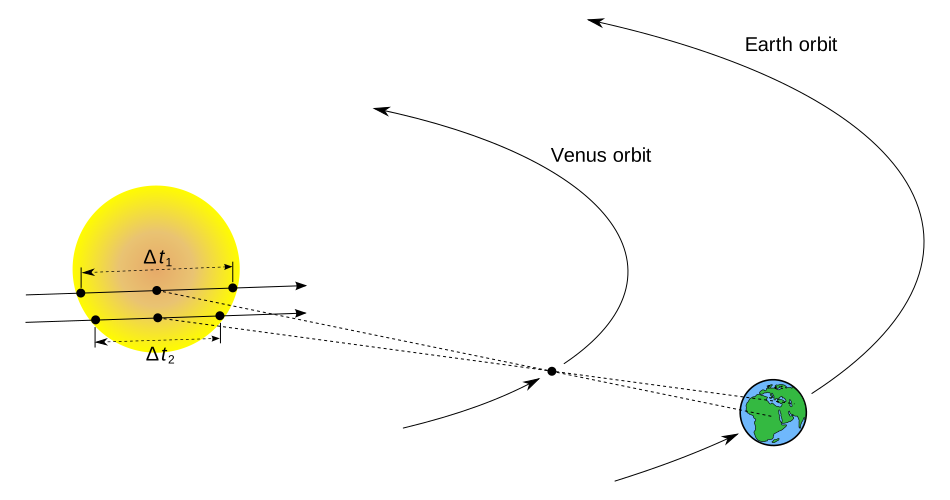
A couple more fun things on the Transit of Venus.
First, a blog post about actually using measurements to calculate the distance to the Sun: Easter Island Transit of Venus, by David Rodriguez.
I particularly like this plot, showing the timing measurement versus position relative to the centre of the Earth:
And the calculation isn't bad, 151+/-20 million km. Only a factor of 10 error larger than the best scientists in the world could do in the 18th century.
Also really neat is this 3D image made by Peter Lawrence (@Advertvision on twitter) which uses image of the transit taken almost simultaneously in the northern Norway (by Pete) and Australia (by expert imager Paul Hause). You can see the parallax of Venus on the disc of the Sun with your own eye, and use red-green 3D glasses to see it in 3D. Must find a pair... :)
"The strongest affection and utmost zeal should, I think, promote the studies concerned with the most beautiful objects. This is the discipline that deals with the universe's divine revolutions, the stars' motions, sizes, distances, risings and settings . . . for what is more beautiful than heaven?" - Nicolas Copernicus
Showing posts with label venus. Show all posts
Monday, June 18, 2012
Wednesday, June 6, 2012
My Transit "Expedition"
Given how much time I've spent lately trying to interest others in the transit of Venus, I got pretty excited myself, so I couldn't resist a trip out to Langstone Harbour on the East coast of Portsea Island to try to get a view. I was tempted out of the house by some tantalising gaps in the cloud on the sunrise horizon.
This great tool which shows the direction and altitude of the Sun's path during a day can show you where I was. Sunrise of course to the North East this close to the Solstice (only due East on the Equinoxes).
Unfortunately it stayed cloudy most of the time. I got a glimpse of the part of the Sun on which Venus was transiting (through my safety glasses), but not long enough to spot the small disk of Venus. Below is a storify of my transit of Venus 2012 experience, including some pictures I took of the clouds! ;)
This great tool which shows the direction and altitude of the Sun's path during a day can show you where I was. Sunrise of course to the North East this close to the Solstice (only due East on the Equinoxes).
Unfortunately it stayed cloudy most of the time. I got a glimpse of the part of the Sun on which Venus was transiting (through my safety glasses), but not long enough to spot the small disk of Venus. Below is a storify of my transit of Venus 2012 experience, including some pictures I took of the clouds! ;)
Friday, June 1, 2012
Transit of Venus Activity on HMS Warrior, 1.30pm and 2.30pm on Tuesday 5th June
Here are details of our transit of Venus activity taking place on board HMS Warrior this Tuesday 5th June 2012 at 1.30pm and 2.30pm. This event is free with a valid entry ticket to HMS Warrior. PLEASE NOTE: it really is Tuesday not Monday. The BBC Things To Do Listing should update soon.
Here is the listing on the HMS Warrior Site.
I made the below worksheet to give out at the event. We'll also have a solar telescope, and safe solar viewers to give out.
Here is the listing on the HMS Warrior Site.
I made the below worksheet to give out at the event. We'll also have a solar telescope, and safe solar viewers to give out.
Labels:
HMS Warrior,
outreach,
scale,
transit,
venus
Friday, May 18, 2012
The Transit of Venus and the Scale of the Universe
(This is based on content I've been developing for upcoming talks on the transit of Venus, which are May 24th to the Pompey Physics Society; May 25th Dom giving talk at Portsmouth Grammar School, and Tuesday June 5th, 1.30pm and 2.30pm Workshop on board HMS Warrior in the Portsmouth Historic Dockyard. Also was used as a basis for this blog post for my Zooniverse friends over at Planethunters. )
On 5th/6th June 2012 Venus will pass between the Earth and the Sun. It's shadow will cross the Sun taking about 6 hours in total, although the length of that which is visible varies significantly depending on where you live on Earth. In the USA the beginning of the transit will be visible as the Sun begins to set on 5th June, while in the UK we'll see the end of the transit after the Sun rises on 6th June.
The planet Venus orbits the Sun inside the orbit of the Earth, and passes between the Earth and the Sun quite frequently. However the planes of the two orbits aren't quite aligned, so most of the time Venus passes either above or below the disk of the Sun. Actual transits are rare, but very predictable. They happen in pairs separated by 8 years, and then after each pair follows a period of either 121.5 or 105.5 years without any transits. The 2012 transit is the second of a pair - astronomers around the world viewed the first transit of the modern age in 2004, and the next transit won't happen until December 2117.
To view a transit of Venus does not need to be technically challenging, but in its simplest form involves looking at the Sun - so some safety precautions must be taken. You must never look directly at the Sun! Serious eye damage or even blindness could occur if you did that, so take this warning seriously! My advice for viewing the transit if you are not a keen amateur astronomer, or able to get to a viewing party, is to either get your hands on a pair of Safe Solar Viewers (like these ones from Astronomers Without Borders), or to view the event via a web cam (like this one from Hawaii where the entire transit is visible, or GLORIA which is planning to show feeds from Australia, Japan and Norway). This last method also has the advantage (especially for UK viewers) of not being affected by local cloud cover, and has exactly zero risk of eye damage! If you come to one of my talks I hope to have solar viewers to hand out.
So why should you care about a black dot crossing the Sun, or perhaps more pertinently, why do I, and an astronomer who studies galaxies, and works in a cosmology department care enough to write a blog post about it and give several talks? Well historically transits of Venus have been very important in helping astronomers understand the scale of the solar system, and from that the scale of the Universe. Basically when Venus crosses the Sun we know that it, the Sun and the Earth are all in a straight line. Very slight differences in the viewing angle from two observers on the Earth can then be used along with our basic knowledge of trigometry to measure the distance to the Sun. For over 100 years, the distance to the Sun measured this way was the most accurate measurement we had.
From knowing the distance to the Sun, we can use slight changes in the apparent position of nearby stars as the Earth orbits the Sun to get their distances (more triangles - this is called the parallax method), and from those stars we calibrate methods which use stars of known or estimated brightness to estimate distances to nearby galaxies, and we jump from distances to nearby galaxies to more distant galaxies and eventually the whole universe. The distances to faraway galaxies have taught us that the universe is expanding and started in a Big Bang around 15 billion years ago, and even if we go to the observations that suggest the universe contains a mysterious "Dark energy" (which won the 2011 Nobel Prize in Physics), they are ultimately based on us knowing the distance to the Sun. So that's why I think it's important.
Here in Portsmouth we're running a workshop about the transit of Venus on HMS Warrior, in the Portsmouth Historic Dockyard. We plan to demonstrate the triangulation method by using it to estimate the distance from the Warrior to the local landmark "The Spinnaker Tower". Two people will stand on the desk and we'll mark out from them the direction to the Spinnaker Tower. Making one of the angles a right angle, we can then estimate the distance to Spinnaker (which is about 300m) by d = b/cos A, where A is the other angle, and b is the distance between the two people on deck.
This isn't exactly the method used in the historical measurements, but it demonstrates the idea. Of course when observing the transit of Venus from two widely separated places on Earth, it's not as easy to measure the angle between the sight lines. What Edmund Halley figured out in 1678 was that if you could measure the times when Venus stars and ends its transit you can get at the same information.
In all of recorded history, we have records of a total of six transits of Venus that have been observed (1639, 1761, 1769, 1874, 1882 and 2004). You have to feel sorry for Johannes Kepler, who predicted the transit which occured in 1631, but then died in 1630. No-one is recorded to have used his prediction that year. Jerimiah Horrocks and Willam Crabtree (two British astronomers who were friends) have the honour of being the first humans known to have seen Venus transit. Horrocks found and improved Kepler's earlier predictions, and both men successfully observed the 1639 transit from Northern England (in December!).
Scientific observation of the transit started in the 18th century following Halley's suggestion to use it to measure the distance to the Sun. There is a hugely rich and entertaining history of these expeditions to view the transit, and several books have been published. I'm just going to tell you a couple of the stories which struck my interest! A lot more, and links to some of the books can be found via the Wikipedia page on Venus Transits, TransitofVenus.org, and TransitofVenus.nl.
For the 1761 transit, two famous explorers got involved. Mason and Dixon (still in Britain, and before they set off to map the USA) were commissioned by the Royal Society to observe the transit from Sumatra. They met in Portsmouth, and set sail from here on HMS Seahorse (which a decade later would have a famous midshipman named Horation Nelson). Enroute to Sumatra they got attacked by the French (the French and English being at war then), and decided to give up. They wrote the Royal Society of their intentions and were promptly told they better get right back on the ship to observe the transit or else. They did, and eventually ended up viewing if from South Africa.
The 1769 transit also had some famous viewers. Captain Cook was ordered to set sail in HMS Endeavour, partially to observe the transit from Tahiti, but then to continue on and look for the mythical "Australia". On that trip they didn't find Australia, but they did land and claim New Zealand. And in Tahiti, they set up a "Fort Venus" from which to stay safe from the natives and view the transit. This voyage is being repeated this year in a replica vessel, and you can follow along at the HMB Endeavour Website.
These 18th century observations results in a measurement of the distance to the Sun of 153+/-1 million kilometers, which was a huge improvement over previous estimates, but not as good as they expected. The timings were thwarted by something which came known as the "black drop effect" where the shadow of Venus seems to bleed into the edge of the Sun. This meant that the start time of the transit could not be measured to better than a few seconds.
In 1874 several more expeditions set out, including several on Royal Navy Ships, such as HMS Volage, one of the largest mixed sail and steam ships ever built, which ferries the British expedition to the Kerguelen Island in the Southern Indian Ocean. Such measurements helped improve the distance measurement to 149.59+/-0.3 million kilometers.
By 1881 it had been decided the distance to the Sun could be estimated better by other methods, although several expeditions still set out, and the first photographs of the transit were taken.
The current best distance to the Sun is 149.5978707 million kilometers, +/- 3 metres, measured using radar ranging to the inner planets. It's known so accurately that we can measure it's changing, growing about 15 metres every century.
The first transit of Venus to happen in the modern age was in 2004. You can find videos online of this event (like the one below), which I was lucky to view from a small observatory near Ithaca, NY while I was studying for my PhD in Astronomy at Cornell University.
For the 2012 transit, apart from encouraging people to view the event as a last in your life time chance, there are couple of new developments. First smart phone technology which didn't even exist in 2004 has allowed the development of a "Transit of Venus Ap". In this Ap you can input the time you view the transit starting and/or ending, and participate in a global experiment to measure the distance to the Sun. Download the Ap in advance to practice inputing your measurement.
Interest in exoplanets has also significantly grown, including the signature that the atmospheres of those planets might have in the observed spectrum of a star when the planet is transiting. The Hubble Space Telescope will try to simulate this type of observation during the transit of Venus, observing the light from the Sun reflected by the Moon (if HST looked at the Sun it would be destroyed) to search for the signature of the atmosphere of Venus. You can read more about the plans on the NASA website.
Anyway I encourage you to get out there, or get online and view the last transit in our lifetime. Use the resources at transitofvenus.org, to work out the timings of the transit from your location, or search for local events. Other useful resources are the Royal Astronomical Society page on the Transit of Venus, in the UK, the HM Nautical Almanac Office. Also of possible interest, the Royal Observatory, Greenwich has a Venus Transit page, and a special (free) exhibit on transits running until September 2012. And the Planethunters project in the Zooniverse also has a special page on the transit.
On 5th/6th June 2012 Venus will pass between the Earth and the Sun. It's shadow will cross the Sun taking about 6 hours in total, although the length of that which is visible varies significantly depending on where you live on Earth. In the USA the beginning of the transit will be visible as the Sun begins to set on 5th June, while in the UK we'll see the end of the transit after the Sun rises on 6th June.
![]() |
| Global Visibility of the 2012 Transit of Venus. |
The planet Venus orbits the Sun inside the orbit of the Earth, and passes between the Earth and the Sun quite frequently. However the planes of the two orbits aren't quite aligned, so most of the time Venus passes either above or below the disk of the Sun. Actual transits are rare, but very predictable. They happen in pairs separated by 8 years, and then after each pair follows a period of either 121.5 or 105.5 years without any transits. The 2012 transit is the second of a pair - astronomers around the world viewed the first transit of the modern age in 2004, and the next transit won't happen until December 2117.
To view a transit of Venus does not need to be technically challenging, but in its simplest form involves looking at the Sun - so some safety precautions must be taken. You must never look directly at the Sun! Serious eye damage or even blindness could occur if you did that, so take this warning seriously! My advice for viewing the transit if you are not a keen amateur astronomer, or able to get to a viewing party, is to either get your hands on a pair of Safe Solar Viewers (like these ones from Astronomers Without Borders), or to view the event via a web cam (like this one from Hawaii where the entire transit is visible, or GLORIA which is planning to show feeds from Australia, Japan and Norway). This last method also has the advantage (especially for UK viewers) of not being affected by local cloud cover, and has exactly zero risk of eye damage! If you come to one of my talks I hope to have solar viewers to hand out.
So why should you care about a black dot crossing the Sun, or perhaps more pertinently, why do I, and an astronomer who studies galaxies, and works in a cosmology department care enough to write a blog post about it and give several talks? Well historically transits of Venus have been very important in helping astronomers understand the scale of the solar system, and from that the scale of the Universe. Basically when Venus crosses the Sun we know that it, the Sun and the Earth are all in a straight line. Very slight differences in the viewing angle from two observers on the Earth can then be used along with our basic knowledge of trigometry to measure the distance to the Sun. For over 100 years, the distance to the Sun measured this way was the most accurate measurement we had.
From knowing the distance to the Sun, we can use slight changes in the apparent position of nearby stars as the Earth orbits the Sun to get their distances (more triangles - this is called the parallax method), and from those stars we calibrate methods which use stars of known or estimated brightness to estimate distances to nearby galaxies, and we jump from distances to nearby galaxies to more distant galaxies and eventually the whole universe. The distances to faraway galaxies have taught us that the universe is expanding and started in a Big Bang around 15 billion years ago, and even if we go to the observations that suggest the universe contains a mysterious "Dark energy" (which won the 2011 Nobel Prize in Physics), they are ultimately based on us knowing the distance to the Sun. So that's why I think it's important.
Here in Portsmouth we're running a workshop about the transit of Venus on HMS Warrior, in the Portsmouth Historic Dockyard. We plan to demonstrate the triangulation method by using it to estimate the distance from the Warrior to the local landmark "The Spinnaker Tower". Two people will stand on the desk and we'll mark out from them the direction to the Spinnaker Tower. Making one of the angles a right angle, we can then estimate the distance to Spinnaker (which is about 300m) by d = b/cos A, where A is the other angle, and b is the distance between the two people on deck.
![]() |
| Google Map image of Portsmouth including HMS Warrior (top) and The Spinnaker Tower (bottom). |
In all of recorded history, we have records of a total of six transits of Venus that have been observed (1639, 1761, 1769, 1874, 1882 and 2004). You have to feel sorry for Johannes Kepler, who predicted the transit which occured in 1631, but then died in 1630. No-one is recorded to have used his prediction that year. Jerimiah Horrocks and Willam Crabtree (two British astronomers who were friends) have the honour of being the first humans known to have seen Venus transit. Horrocks found and improved Kepler's earlier predictions, and both men successfully observed the 1639 transit from Northern England (in December!).
Scientific observation of the transit started in the 18th century following Halley's suggestion to use it to measure the distance to the Sun. There is a hugely rich and entertaining history of these expeditions to view the transit, and several books have been published. I'm just going to tell you a couple of the stories which struck my interest! A lot more, and links to some of the books can be found via the Wikipedia page on Venus Transits, TransitofVenus.org, and TransitofVenus.nl.
For the 1761 transit, two famous explorers got involved. Mason and Dixon (still in Britain, and before they set off to map the USA) were commissioned by the Royal Society to observe the transit from Sumatra. They met in Portsmouth, and set sail from here on HMS Seahorse (which a decade later would have a famous midshipman named Horation Nelson). Enroute to Sumatra they got attacked by the French (the French and English being at war then), and decided to give up. They wrote the Royal Society of their intentions and were promptly told they better get right back on the ship to observe the transit or else. They did, and eventually ended up viewing if from South Africa.
The 1769 transit also had some famous viewers. Captain Cook was ordered to set sail in HMS Endeavour, partially to observe the transit from Tahiti, but then to continue on and look for the mythical "Australia". On that trip they didn't find Australia, but they did land and claim New Zealand. And in Tahiti, they set up a "Fort Venus" from which to stay safe from the natives and view the transit. This voyage is being repeated this year in a replica vessel, and you can follow along at the HMB Endeavour Website.
These 18th century observations results in a measurement of the distance to the Sun of 153+/-1 million kilometers, which was a huge improvement over previous estimates, but not as good as they expected. The timings were thwarted by something which came known as the "black drop effect" where the shadow of Venus seems to bleed into the edge of the Sun. This meant that the start time of the transit could not be measured to better than a few seconds.
| The black drop effect, photographed in 2004. |
In 1874 several more expeditions set out, including several on Royal Navy Ships, such as HMS Volage, one of the largest mixed sail and steam ships ever built, which ferries the British expedition to the Kerguelen Island in the Southern Indian Ocean. Such measurements helped improve the distance measurement to 149.59+/-0.3 million kilometers.
![]() |
| HMS Volage from the RAS Archives |
By 1881 it had been decided the distance to the Sun could be estimated better by other methods, although several expeditions still set out, and the first photographs of the transit were taken.
![]() |
| A photograph of the 1882 transit, taken by a US expedition. |
The first transit of Venus to happen in the modern age was in 2004. You can find videos online of this event (like the one below), which I was lucky to view from a small observatory near Ithaca, NY while I was studying for my PhD in Astronomy at Cornell University.
For the 2012 transit, apart from encouraging people to view the event as a last in your life time chance, there are couple of new developments. First smart phone technology which didn't even exist in 2004 has allowed the development of a "Transit of Venus Ap". In this Ap you can input the time you view the transit starting and/or ending, and participate in a global experiment to measure the distance to the Sun. Download the Ap in advance to practice inputing your measurement.
Interest in exoplanets has also significantly grown, including the signature that the atmospheres of those planets might have in the observed spectrum of a star when the planet is transiting. The Hubble Space Telescope will try to simulate this type of observation during the transit of Venus, observing the light from the Sun reflected by the Moon (if HST looked at the Sun it would be destroyed) to search for the signature of the atmosphere of Venus. You can read more about the plans on the NASA website.
Anyway I encourage you to get out there, or get online and view the last transit in our lifetime. Use the resources at transitofvenus.org, to work out the timings of the transit from your location, or search for local events. Other useful resources are the Royal Astronomical Society page on the Transit of Venus, in the UK, the HM Nautical Almanac Office. Also of possible interest, the Royal Observatory, Greenwich has a Venus Transit page, and a special (free) exhibit on transits running until September 2012. And the Planethunters project in the Zooniverse also has a special page on the transit.
Thursday, March 29, 2012
Visiting Jodrell Bank as part of the UK National Astronomy Meeting
I'm in Manchester this week at the UK National Astronomy Meeting. As part of this, yesterday evening I went on a visit to the Jodrell Bank Observatory, with 120 other astronomers.
![]() |
| NAM Astronomers at JBO |
![]() |
| Jodrell Bank and a sheep |
![]() |
| The Sun through the dish |
![]() |
| Jodrell Bank and some daffodils |
![]() |
| Jodell Bank and spring blossom |
![]() |
| Jodrell Bank and a hedge of forsythia |
We got to walk under the dish too. Here we are crossing the track which the telescope uses to rotate in azimuth.
![]() |
| Jodrell Bank azimuth track |
![]() |
| Looking up at the base of Jodrell Bank |
![]() |
| That's me directly under the centre of the dish |
Required picture of me with the dish
We also got a tour of the control room - and the set of BBC Stargazing LIVE of course.
And we're astronomers, so we like the details - this is some of the computers which run Jodrell Bank when it works with the eMerlin network of UK radio telescopes.
It need as "Totally Accurate Clock" to do this (actually that's totally true).
Our visit ended with a dinner in the cafe. We sat outside with the above view of the sky, and I saw Venus in the daytime finally. :) I think it's in the below image, but I haven't spotted it yet!
![]() |
| Moon and Venus in daytime, 28th March 2012 |
Labels:
moon,
NAM,
photos,
radio astronomy,
spring,
telescopes,
venus
Subscribe to:
Posts (Atom)